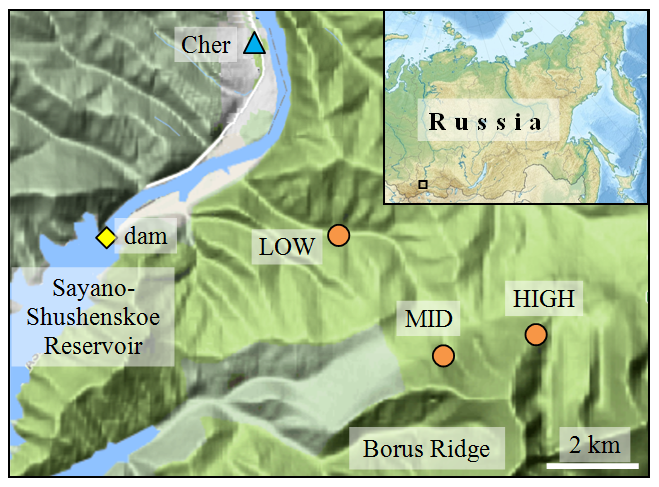
New details of tree ring formation regulation were revealed from spruce wood anatomy at Borus Ridge, Western Sayan
12.21.2018
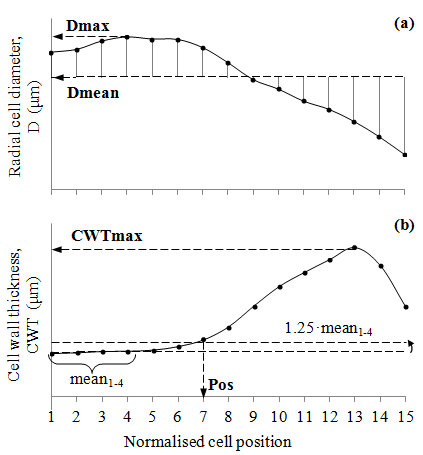
Wood anatomy of Picea obovata Ledeb. was offered as spatiotemporal proxy record for tracheid differentiation kinetics, because it has such advantages as much longer cover period and less demanding measurements. External and internal regulation of earlywood-to-latewood transition and properties of latewood were considered. The values and interrelations between cell number, tree ring width, maximal and mean radial cell diameter, maximal cell wall thickness and position of the transition to thick-walled tracheids were investigated within site and along the altitudinal gradient. Correlations with moving 21-day climatic series were used to estimate high-resolutional external influences. Relationships between tree ring traits are spatially stable and close within one stage of differentiation and between cells production and expansion. Relationships between sites differ in upper and lower parts of the gradient. Most of traits respond to the primary limiting factors near summer solstice; however, maximal cell wall thickness responds positively to the temperatures at the +10°C threshold. Altitudinal anatomical patterns revealed interaction of intrinsic and external factors in the regulation of tracheid differentiation. Timing of climatic response highlighted role of photoperiod as a trigger in the earlywood-to-latewood transition, and crucial role of the growth season ending for latewood development.
Details about this study were described in the manuscript titled “Siberian spruce tree ring anatomy: imprint of development processes and their high-temporal environmental regulation”, that will be published soon in the international journal “Dendrochronologia “.